
With the current swirl of headlines surrounding tariffs, inflation, and market volatility, it’s understandable to feel a little uneasy about what the future holds. As investors, it’s natural to want to protect what you’ve worked so hard to build. However, history shows us that reacting to short-term market noise can often do more harm than good.
A Brief Look at Tariffs and the Markets
Tariffs—essentially taxes on imported goods—have been part of the economic landscape for centuries. While they are often used as tools of trade policy, they can have ripple effects on markets in the short term. Recent history gives us a useful guide. In 2018, when the U.S. imposed tariffs on steel, aluminum, and a variety of goods from China, markets reacted with volatility. However, by the following year, markets rebounded as uncertainty subsided and businesses adapted.
Looking further back, other periods of trade tension tell a similar story. The Smoot-Hawley Tariff Act of 1930, which raised duties on hundreds of imported goods, is often cited as exacerbating the Great Depression. However, more recent tariff event —such as the steel tariffs imposed by President George W. Bush in 2002—had more localized and temporary effects on the markets. While those tariffs caused some market disruption, the broader economy and markets continued to grow in the years that followed. These examples show that while tariffs can create uncertainty, they are just one of many factors influencing long-term market performance.
Avoid the FUD (Fear, Uncertainty, Doubt)
It’s easy to feel anxious when headlines paint a picture of instability. The concept of FUD— Fear, Uncertainty, and Doubt captures how emotions can drive investors to make reactive decisions. FUD can spread quickly during times of geopolitical tension or market turbulence, but it’s often based on speculation rather than fact. The challenge for investors is to resist making long-term decisions based on short-term fears. History has shown that markets are resilient. The chart below from Ritholtz Wealth Management shows the S&P 500 from 1950. Every circle represents a selloff, ranging from declines of 5% to over 20%. The larger the circle, the larger the selloff.
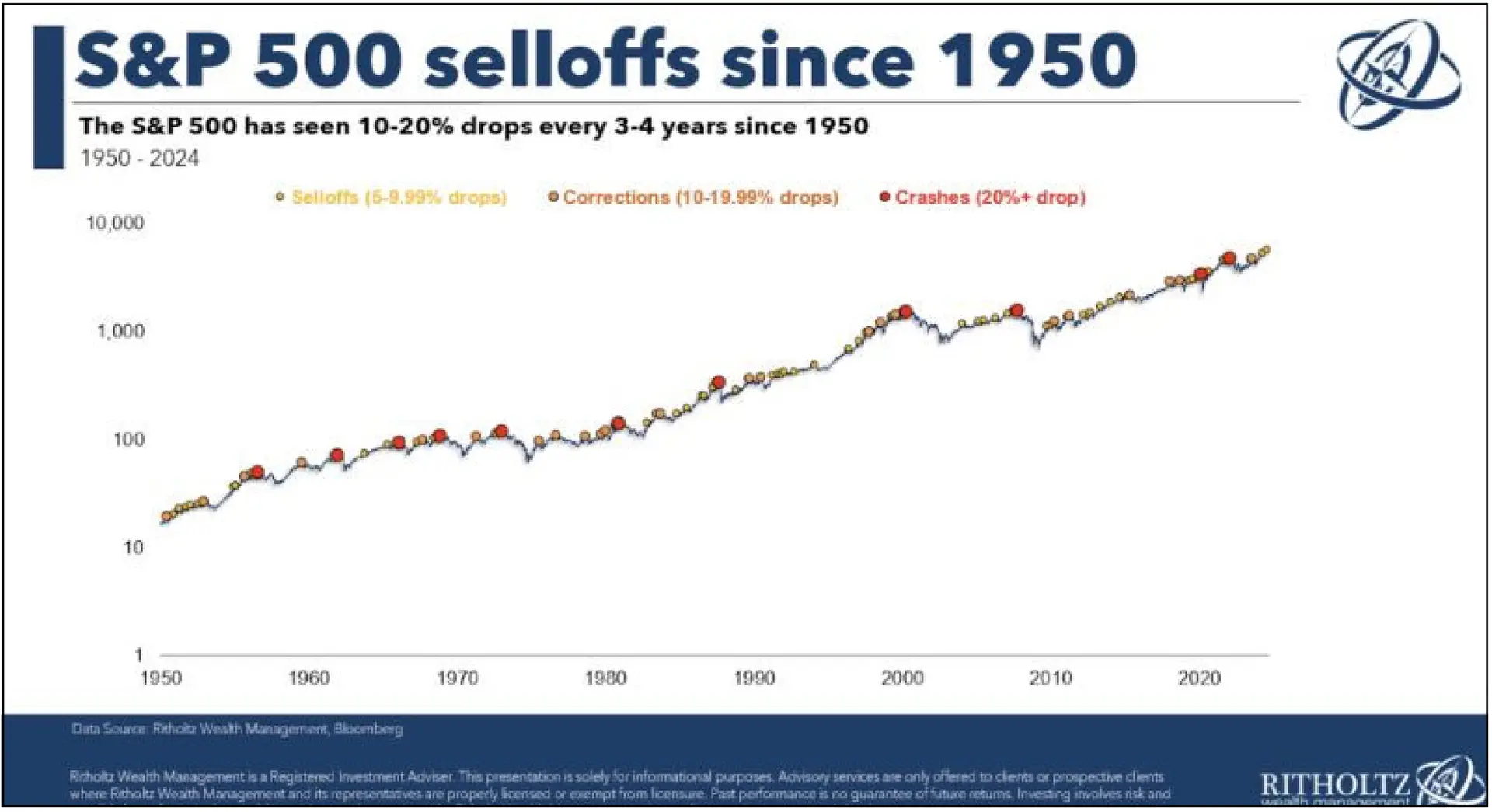
The anxiety that dominated headlines during past tariff disputes, financial crises, or political upheavals often fades as new opportunities emerge and the economy finds ways to adapt. Staying grounded in your long-term goals can help keep FUD from clouding your judgment.
Staying the Course
Every investor’s situation is unique, but a few principles remain constant:
- Keep emotions in check: Reacting to short-term headlines can lead to costly mistakes. Instead, lean on your financial plan as a guide through uncertain times.
- Stay diversified: Spreading investments across different asset classes helps cushion against market volatility.
- Focus on long-term goals: Whether you’re saving for retirement, a major life event, or leaving a legacy, remember that markets have historically trended upward over the long term.
- Have a sound withdrawal strategy: For those already in retirement, without a paycheck to replenish savings, it can be especially nerve-wracking to watch markets fluctuate. Maintaining a cash reserve to cover several months’ worth of expenses can help avoid selling investments during market downturns. Regular portfolio reviews to ensure your asset allocation aligns with your spending needs can also provide reassurance. Remember, even in retirement, the goal is to make your savings last for the years ahead— not just today.
We’re Here to Help
At NHTrust, we understand that uncertainty can feel overwhelming. That’s why we take a thoughtful, measured approach to wealth management—helping you stay focused on your long-term goals, no matter what the headlines may bring.
If you have any questions or would like to discuss how your portfolio is positioned, please don’t hesitate to reach out to your Wealth Advisor. We’re here to provide the perspective and guidance you need to navigate market ups and downs with confidence.
Together, we can weather the storms and stay on course toward your financial future.