

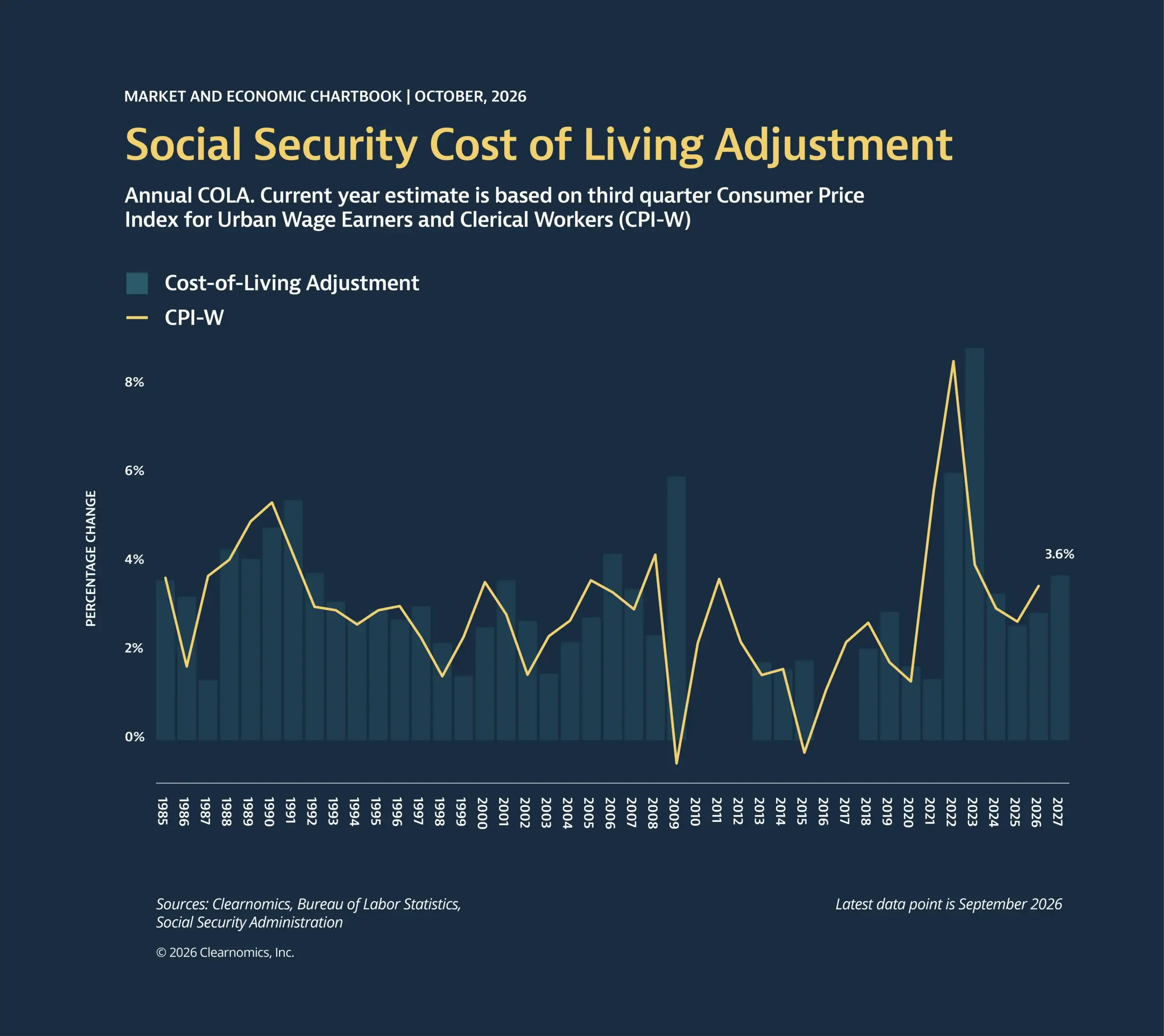
The Social Security Administration recently announced a 3.6% cost-of-living adjustment (COLA) for 2027. Excluding the unusually large increases following the COVID pandemic, this is the largest adjustment since 2012.
But why does Social Security provide cost-of-living adjustments in the first place?
Think about it this way. During our working years, we may receive annual pay raises to help offset rising costs. We might also change jobs or pursue a promotion to increase our income. Once we retire, those opportunities become more limited, but the cost of groceries, utilities, healthcare and other everyday expenses continues to rise.
That’s why Social Security provides annual cost-of-living adjustments. They’re designed to help retirees maintain their purchasing power as prices increase.
But here’s a question worth considering: Will the 3.6% increase be enough to keep up with your cost of living?
Your Cost of Living May Be Different
The Social Security Administration calculates its annual COLA using a measure of inflation known as the Consumer Price Index for Urban Wage Earners and Clerical Workers (CPI-W). While this provides a consistent way to measure changes in prices, it doesn’t necessarily reflect how every retiree spends their money.
When we work with you to plan for retirement, we factor in an assumed rate of inflation, so our projections account for the rising cost of living over time. For example, if you plan to spend $10,000 a year on travel, we increase that amount annually in our projections to account for rising travel costs. We may also use different inflation assumptions for expenses such as healthcare and education, which can rise faster than overall inflation.
Prices don’t rise uniformly, and we don’t all experience inflation the same way.
Someone who owns their home outright may experience inflation differently than someone who rents. Healthcare costs may represent a significant portion of one retiree’s budget, while another may spend more on travel, transportation or other activities.
There’s another consideration for retirees enrolled in Medicare. For those who have their Medicare premiums deducted from their Social Security benefits, an increase in those premiums can offset some of the annual COLA, leaving them with a smaller increase in their monthly payment than they might expect.
A 3.6% increase in Social Security benefits may be more than enough to offset rising expenses for some retirees, while others may find their costs increasing at a faster pace.
Planning for More Than Just Inflation
Inflation is just one of several assumptions we use when developing a retirement plan. Investment returns, spending needs and other factors also play a role. But these are projections, not guarantees, and actual results may be different from what we anticipate.
That’s why it’s important to revisit your retirement plan periodically. As your circumstances change, your plan may need to change as well. The same applies to your investment portfolio. It should be reviewed to ensure that it continues to reflect your income needs, risk tolerance and long-term goals, including the need to keep pace with inflation.
While we don’t know what future inflation rates or market returns will be, there are steps we can take to prepare. Reviewing your assumptions and making adjustments when needed can help keep your retirement plan on track.
It’s also important to build some flexibility into your retirement spending. Expenses such as travel, entertainment and other discretionary purchases can often be adjusted when circumstances change. Having that flexibility can help reduce the amount you need to withdraw from your investments during more challenging periods, giving your portfolio more time to recover.