

What the midterm elections can, and cannot, tell us about the markets:
Election season has a way of making every headline feel urgent and every market move seem tied to politics.
As November 3 approaches, investors are hearing increasingly confident predictions about what a change in congressional control could mean for taxes, government spending, healthcare, energy policy, artificial intelligence and the financial markets. All 435 House seats and 35 Senate seats are on the ballot.
The policy implications are real. Yet after decades of watching markets through elections, recessions, geopolitical events and policy shifts, one lesson stands out: An election outcome may alter the policy landscape without necessarily changing the fundamentals of a well-constructed financial plan.
In fact, the greatest election-related risk to a portfolio may not be which party wins. It may be the temptation to make a lasting financial decision in response to a temporary political reaction.
Historically, investor behavior during periods of uncertainty has often had a greater impact on long-term outcomes than the uncertainty itself.
The portfolio risk that does not appear on a ballot:
Politics is personal. Investing requires a different discipline.
When investors strongly favor one party or worry about the policies of another, it can be difficult to separate expectations for the country from expectations for the stock market. A disappointing result may create an understandable urge to reduce stocks, move to cash or simply wait until the outlook feels more comfortable.
The challenge is that markets often begin adjusting long before investors feel comfortable enough to act.
Markets respond to economic growth, interest rates, inflation, corporate earnings, valuations, innovation and events around the world. Political decisions can influence these factors, but the connection between an election result and market performance is seldom simple or immediate.
Over time, corporate earnings, economic growth, interest rates and valuations have generally mattered far more than the outcome of any single congressional race.
Separating our preferences as voters from our decisions as investors is an important part of maintaining a disciplined financial plan.
What history tells us, and what it does not:
History can provide valuable perspective, but history is often a better teacher of humility than prediction.
Since 1933, the S&P 500 has produced positive average returns during presidential election years, midterm election year and years without a federal election.
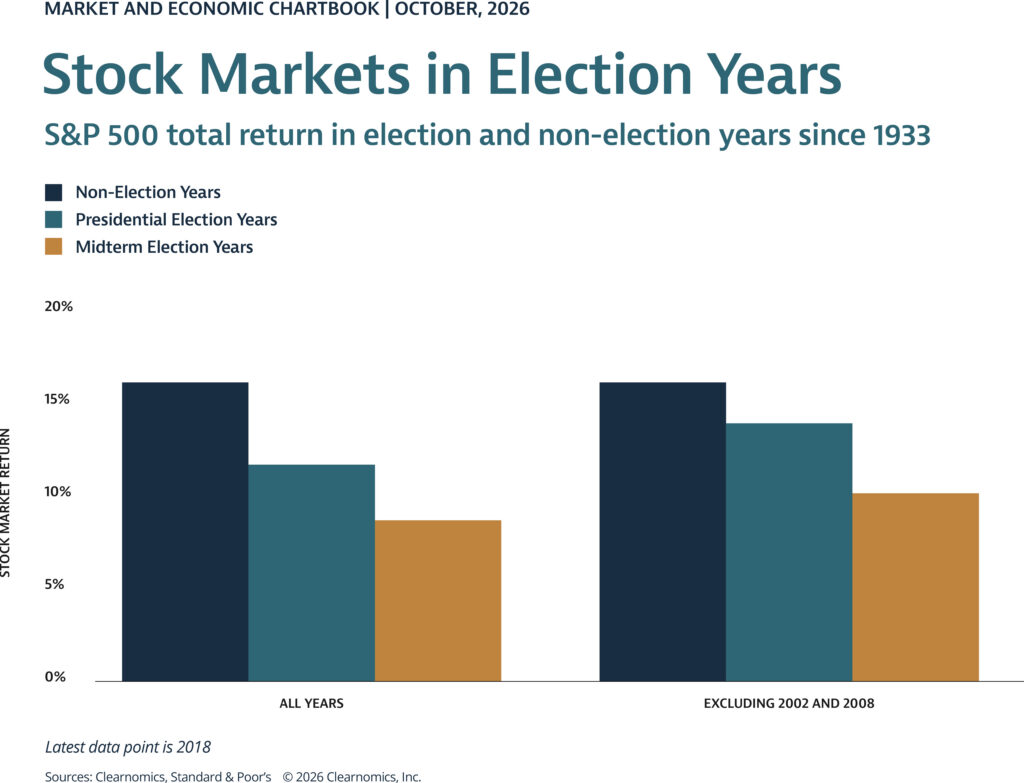
One lesson I emphasized in the classroom and continue to discuss with clients today is that averages without context can be misleading.
The chart illustrates this point. When 2002 and 2008 are excluded, the differences among the three categories narrow. Those years were shaped by the decline following the technology-market bubble and the global financial crisis, not simply by the election calendar.
That does not mean difficult years should be ignored. They remain an unavoidable part of the investor experience. The comparison does, however, show how a small number of significant economic events can influence long-term averages and make an apparent election pattern seem more meaningful than it may actually be.
The point is not that election years are inherently favorable for stocks or that positive returns should be expected following the 2026 midterms. Every election occurs within a unique economic, market and geopolitical environment.
The more reasonable conclusion is that markets have produced positive average returns at different points in the election cycle. Election timing and party labels, on their own, have not provided a dependable basis for changing a long-term investment strategy.
Where the election could have a more direct effect:
While broad portfolio decisions should not depend on an election forecast, policy changes may create opportunities and challenges within certain industries.
Artificial intelligence, energy infrastructure, healthcare, financial services, tax policy and defense spending are among the areas where legislative and regulatory changes could create both opportunities and risks. Artificial intelligence and data centers, for example, continue to drive demand for electricity, infrastructure investment and permitting capacity.
These developments are worth monitoring, but they do not necessarily call for a change in strategy. A diversified portfolio is designed to participate in opportunities across a range of economic and policy environments rather than depend on a single election outcome.
Turn election anxiety into a productive review:
In my experience, investors rarely regret maintaining a disciplined plan through periods of political uncertainty. More often, the costly decisions occur when emotion replaces process.
Rather than trying to forecast election results or the market’s short-term reaction, investors are often better served by asking:
- Have my goals or cash-flow needs changed?
- Has market performance caused my allocation to drift?
- Is my portfolio more concentrated than I intended?
- Would a proposed policy materially affect my personal financial plan?
These questions bring the discussion back to an investor’s own circumstances and to decisions that are actually within the investor’s control.
Keep the election in perspective:
The midterm elections matter. Policy decisions can influence industries, affect business incentives and shape investor sentiment.
A durable financial plan, however, should be built to withstand a wide range of political and economic outcomes.
At NHTrust, we believe portfolios should be built around client objectives, not political predictions. Markets have navigated changing administrations, shifting congressional majorities, recessions, wars, inflationary periods and technological revolutions. While elections may influence the path, long-term investment success has historically depended far more on discipline, diversification and patience than on correctly forecasting the next political outcome.