
This time of year often brings giving a little more to the forefront. When considering a gift, the first question is often how much. I’d suggest starting with a different question: What do I want this gift to accomplish?
Perhaps you want to help a grandchild with college, give an adult child a financial head start or support an organization you care about. Each may call for a different approach. That’s why I like to start with the purpose. Once you know what you want the gift to accomplish, you can think more thoughtfully about who should receive it, what asset or account makes sense, and how and when to give.
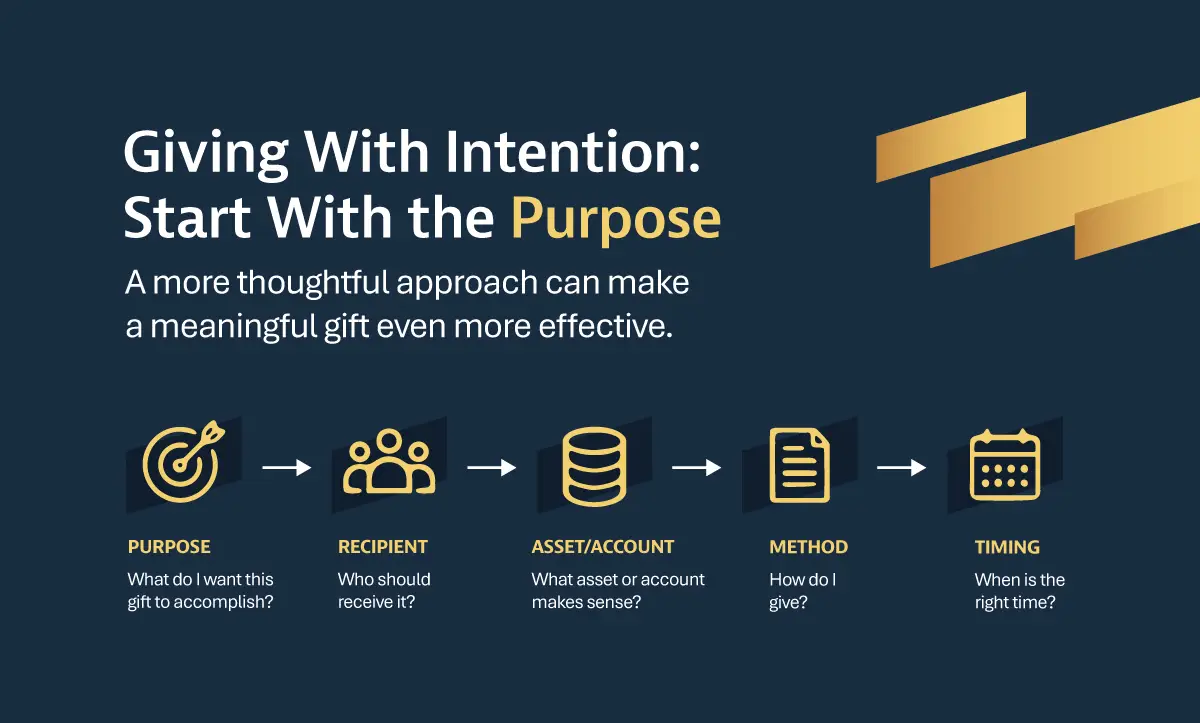
The order matters. Starting with the goal may help determine how much to give, which asset or account to use, and whether timing creates other planning opportunities. Investment values, interest rates and tax circumstances change, which can make timing an important consideration.
If the Goal Is Education
For many parents and grandparents, helping with education is especially meaningful. But how you give matters.
A 529 education savings plan can provide funds for future qualified education expenses, with tax-free growth and federal income-tax-free withdrawals when used for qualified expenses.
But what if tuition is due now? Paying the school directly may be worth considering. Under federal gift-tax rules, tuition paid directly to a qualifying educational organization is generally excluded from taxable gifts.
Funding education years from now and paying tuition today are different planning objectives. The timing helps determine which strategy deserves consideration.
If the Goal Is a Financial Head Start
Education isn’t the only time families may want to help the next generation. Maybe it’s a down payment on a first home, starting a career or raising a family. With housing and everyday expenses costing more, that assistance may have a different impact than it would have several years ago. The amount matters, but so does understanding what the gift is intended to make possible.
Here, I think the family questions matter just as much as the financial ones. Is the money simply a gift? If one child receives significant help today, should that be considered in future estate-planning decisions? These aren’t simply tax questions. They are family questions, and being clear about expectations can be just as important as getting the mechanics right.
In 2026, an individual can generally give up to $19,000 per recipient under the federal annual gift-tax exclusion. Giving more doesn’t necessarily mean gift tax is due, but it may require a federal gift-tax return and should be considered as part of the broader estate plan.
There is another consideration I think is equally important: having enough assets to make a gift isn’t necessarily the same as being able to comfortably afford it. A significant lifetime gift should still be considered alongside your retirement income, liquidity, healthcare needs, and other long-term goals. That can be particularly important when inflation has increased the cost of maintaining your own lifestyle and higher interest rates affect borrowing and cash flow. Generosity shouldn’t come at the expense of your own financial security.
If the Goal Is Charitable Giving
The same thinking applies to charitable giving. You may know which organization you want to support and how much to give, but another question remains: What is the most appropriate asset or account to use?
Cash may be the simplest choice, but it isn’t always the most tax efficient. If you own appreciated investments, donating securities directly to a qualifying charity may provide a charitable deduction while also avoiding the capital gain that could result from selling the investment first, subject to applicable tax rules.
That can be particularly relevant after periods of strong market appreciation. Even when markets feel unsettled, individual holdings may carry significant unrealized gains or represent a concentrated position. Charitable giving can therefore be part of the broader portfolio-planning conversation, not simply a separate decision about how much to give.
That distinction is particularly relevant in today’s market. While headline index movements can appear relatively modest, there has been significant variation in the performance of individual stocks, reinforcing the importance of looking beneath the surface of a portfolio.
If you have a highly appreciated or concentrated position, it may be worth comparing the tax and portfolio implications of donating securities directly with writing a check.
For those who are eligible, a qualified charitable distribution (QCD) provides another option. Beginning at age 70.5, an eligible IRA owner may generally make a QCD directly to a qualifying charity. The distribution is generally excluded from taxable income and can count toward an RMD, if one applies.
The charitable intention may be exactly the same, but how you fund the gift can produce a very different tax result.
Giving is personal, but good planning can help make a meaningful gift even more effective.
Before deciding how much to give, start with the purpose: What do I want this gift to accomplish? Markets will change, tax rules will evolve and financial circumstances will shift. Starting with the purpose can help determine what to give, how to give it and when.